Breast Augmentation

This is one of the most commonly performed surgical cosmetic procedures. However, for various reasons, it is also one that generates the most questions (see "Controversies and Considerations" below).

The idea of surgically enhancing the breast to make it larger has been around for a long time, and there have been various attempts to practically apply the concept (including moving benign tumours to the breast and paraffin injections). However, the first “modern” augmentation, using a silicone based implant, did not occur until the early 1960s. Today, in general, a silicone-lined implant with a silicone gel filling is used. Usually, the approach is through a small cut (generally 4 cm or less) on the underside the breast in the fold (the infra-mammary fold).  This scar is pretty well hidden.

While the principle of the operation is simple (increase the volume by putting in an implant), the individual details are important.
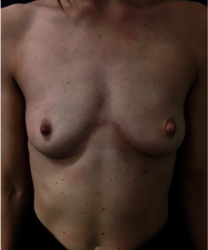
Breast augmentation has three effects – firstly simply increasing the volume of the breast, secondly it can expand the base of the breast, and finally it can expand loose skin.

Breast augmentation will not address sag – it may occasionally disguise it, but it does not actually lift the breasts. For that, a mastopexy (breast uplift) would be needed.

Dual Plane1 before

Before

Dual Plane2 After

After

This lady in her mid-30s had ”empty” appearing breasts, that gave an impression of mild sag.  This was addressed with implants partially under the muscle (dual plane).

Dual Plane2 before

Before

Dual Plane2 After

After

This lady in her early 40s had always had underdeveloped breast tissue and had breast implants partially under the muscle (dual plane) to improve the appearance.

Dual Plane3 before

Before

Dual Plane3 After

After

This lady in her mid-20s had reasonable breast tissue development, but wanted to feel more proportionate, so had breast implants placed over the muscle (”subglandular”).

Controversies and considerations

There is a group of patients who, following breast augmentation, feel that they are generally tired, may get muscle aches or generally not feel great.  The collection of these and other non-specific symptoms has been called “breast implant illness”.  It is a controversial subject as from a medical point of view there is disagreement on how exactly to diagnose it, with some experts feeling it is not an actual condition.  This of course does not mean that breast implant illness is not real or that it does not exist – rather it is a reflection of the fact that our understanding of the matter is currently still developing . The treatment for it has been suggested to be removal of the implants with or without their capsules, however, that is again controversial, as the procedure itself carries risks, and as yet the benefits remain uncertain.  More information and time will hopefully clarify this difficult subject further. 

Whenever an artificial material is put into the body, the body “walls it off” by making scar tissue around it. Around a breast implant, we call this a capsule and it develops within a few short weeks after surgery.  This process is quite normal. What is not normal is when that capsule tightens down and becomes painful or changes the shape of the implants, in which case we call it capsular contracture.  In textured implants under the muscle, around 3.5% of women will have this within 10 years and with smooth about 5%.  The rates, particularly with smooth implants, are much higher over the muscle.

Perhaps more than any other operation, breast augmentation generates uncertainty about what option to go for.  Smooth or Textured implants? Teardrop ("anatomical") or round? And so on. In the end, there is no one-size-fits-all answer, and the plan needs to be tailored to the individual patient and their needs.

Below is a list of common dilemmas patients face about breast augmentations along with my thoughts on them.

  • Teardrop vs round implants – teardrop (or anatomical) implants are shaped so that more of the volume is at the bottom. Theoretically, this can give a more “natural” shape to the breasts, which can be great in the right patient. However, there are disadvantages compared with round implants, such as the lower volume higher up (and so potentially less fullness around the cleavage), and the possibility of the implants flipping so that they are upside down. I usually find that round implants give good results, and don't have the risk of rotating that teardrop implants do, so tend to veer towards them, but as always, there are exceptions.
  • Textured vs smooth implants – whether an implant is “smooth” or “textured” refers to its surface, though once inside the breasts you won’t really be able to feel a consequential difference. The differences are more to do with how the implants “behave” within the body. Smooth implants may move around more and carry a higher risk of needing further operation within a few years due to capsular contracture. Textured implants, are the opposite – but carry a risk of a type of cancer (BIA-ALCL). This is very rare, and as at 2021, in Mentor breast implants the risk is about 1 in 24,000 (data from Mentor). To give perspective, an individual’s risk of death in a road accident in the UK is around 1 in 20,000 per year and about 1 in 240 over a lifetime (source - click here).
  • What size implant? – There is definitely no correct answer to this question. It’s very variable from individual to individual. While there can be a natural desire to want to go larger, one has to bear in mind that there are greater risks (such as breast sag) as the implants go larger. And there is no reliable science or algorithm to tell you the answer, though many have tried. So how do you judge the right size? In general, it’s a combination of trying on sizers in clinic and/or the “rice test”, an honest discussion with your surgeon about what kind of result you are looking for, and your surgeon’s instincts.

Over the muscle vs under the muscle - Breast implants placed over the pectoral muscle (sub-glandular) have the advantage of often giving more “fullness” and minimising the damage to the muscle. However, they can also, therefore, look more “fake” than under the muscle or dual plane. Furthermore, there is a greater risk of capsular contracture over the muscle (internal scar tissue that can cause pain and deformity) especially with smooth implants. Under the pectoral muscle, implants tend to be less “fake”, but similarly may look less “full” than over the muscle. Going under the muscle also means having to partially cut the muscle, though I have not seen any long-term functional consequence to this, a risk of the implants moving around as the muscle contracts ("implant animation"). In general, I would tend to put implants as under the muscle/dual plane where I think going over the muscle would look too fake.

Under the muscle vs dual plane - Technically speaking “under the muscle” means that the entire breast implant is completely covered by muscle. Dual plane basically means the top of the implant is covered by the muscle and the bottom bit is under the gland (so it’s a bit under and and bit not!). It has the advantage of hiding the “fakeness” of the implants and of allowing the lower part of the implant to expand out the lower pole. From a risk profile point of view, it is similar to under the muscle. In general, I find if choosing between under the muscle and dual plane, I get a better result from dual plane, though there are of course exceptions.

  • Surgical Time

    Around 1 hour
  • Hospital Stay

    Daycase
  • Shower

    Day after
  • Woundcheck/Suture Removal

    1 week
  • Back To Work

    1-2 weeks
  • Full Recovery

    Usually by 6 weeks
  • Exercise

    After 6 weeks
  • Other Notes

    Post-operative sports bra 6 weeks

Find us

Renacres Hospital,

Renacres Ln,

Halsall,

Ormskirk

L39 8SE

Contact

Information

Website by Beachshore